
Kuwait was the first of many countries in the MENA region to enter the wireless communication industry by establishing Mobile Telecommunications Company in 1983. MTC (currently named Zain) was mainly owned by the Kuwaiti Government with a 49% stake of the company, which was reduced to 25% in 2001. Wataniya Telecom was commercially launched in 1999 as the first privately owned operator in Kuwait, which is when the government allowed the establishment of a second operator. Viva, the third operator, initiated its operations in 2008.
The Kuwaiti market evolved dramatically throughout the years by going through a monopolized market controlled by Zain to oligopoly market of three. Despite the long history in the telecom industry, the market remains the least liberalized in the region. The country does not have an independent telecom regulator and therefore, the industry lacks proper regulatory framework and is very slow in developing its infrastructure with new technology. A new telecom and communication legislation passed by the National Assembly in June of 2011, which would address and resolve the major challenges the operators and customers are facing.
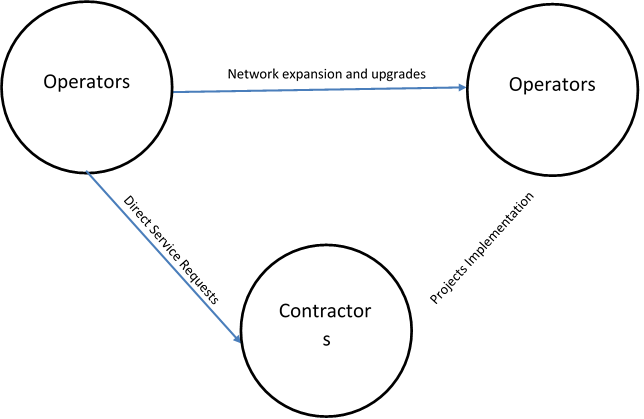
The telecommunications industry in Kuwait is similar to other markets where operators’ expansions and development has a direct impact on the profits of the vendors, which in turn positively impact contractors and subcontractors.
Operators
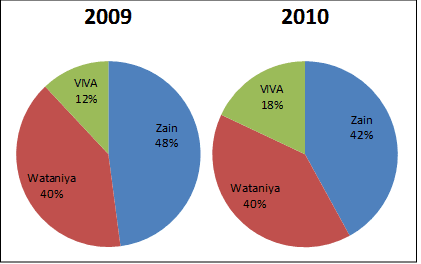
Zain have been losing its market share at a faster rate compared to the other two operators since the 2008 entry of VIVA. Completion is expected to get tougher once the “Mobile Number Portability” (MNP) is rolled out to consumers in the near future. According to Zawya, Zain has maintained its lead in the local market in terms of mobile subscribers despite losing 6% to VIVA in one year only. Unlike Zain, Wataniya sustained its share of without losing any to either Zain or VIVA last year, Figure 2.
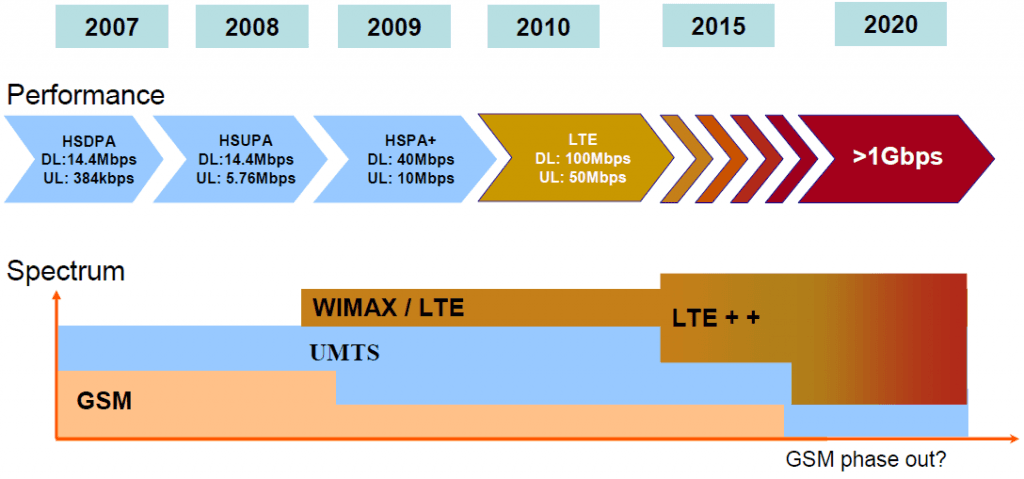
Despite the fact that the Kuwaiti market is growing at a steady pace but the market is still low in penetration and high in Average Revenue Per User (ARVP) which makes the market very attractive to operators. Fierce competition among the three operators mandates introduction of new services especially broadband. All three operators have been modernizing their infrastructure around the same time for HSDPA, HSUPA, HSPA+, and now Long Term Evolution technology (LTE).
Zain, Wataniya, and VIVA are planning to modernize their telecom infrastructure to cope with the current and upcoming technologies. In addition to modernization, all three operators will be adding LTE to their networks. Development and expansion of such caliber across all three operators will generate demand for the telecom engineering services pre, during, and post the projects.
Zain, Wataniya, and VIVA are planning to modernize their telecom infrastructure to cope with the current and upcoming technologies. In addition to modernization, all three operators will be adding LTE to their networks. Development and expansion of such caliber across all three operators will generate demand for the telecom engineering services pre, during, and post the projects.
None of the operators has yet discussed their strategy in modernizing and adding LTE to their network but one of two options will be undertaken. The first is to undergo a single Radio Access Network (RAN) upgrade where mobile service providers will not need to have multiple base stations for each cellular standard. This means additional land acquisition cost are not necessary as a single base station could support all cellular standards, whether 2G, 3G or even 4G LTE. The other approach is modernizing the current network and make it compatible with LTE standards.
Zain
Zain is the first Kuwaiti GSM operator in Kuwait, which was majorly owned by the Kuwaiti Government via its investment arm, Kuwait Investment Authority (KIA). Currently KIA owns 24.608% of Zain and 16.431% is owned Al Kharafi family via Al Khair Al Wataniya Company. Due to its early and sole entry in the Kuwaiti market for almost 15 years gave the company a competitive advantage in grapping and holding the majority share of the market.
Performance Indicators
2009
2010
Change (%)
Total revenues (KWD)
424,035,000
424,924,000
0.21%
Net profit (KWD)
158,357,000
158,055,000
-.19%
No of Mobile Subscribers
1,838,000
1,870,000
1.74%
Average Revenue Per User – ARPU (USD)
56
–
NA
Penetration Rate – Mobile
51.6%
–
NA
% of Postpaid Subscribers
34.11%
33.79%
Zain had a long lasting relationship with many vendors especially Motorola. Motorola have been servicing and upgrading Zain’s network since 1994. The company has not been as fortunate as it used to be in grapping opportunities from the other vendors in the recent years where other vendors such as Huawei dominated their market and acquired their market share in upcoming projects.
Zain is currently operating approximately 3000 sites of several technologies mainly using Motorola equipment. Because after the acquisition of Motorola by NSN and the discontinuity of their products, Zain will be forces to swap their equipment with another vendor. It is most likely that Huawei will be the vendor for the swap project.
Date
Vendor
Description
Value
06/2000
Motorola
Countrywide capacity enhancement at 1800 MHz on the MTCNet GSM network.
$14 million
09/2000
Motorola
Expanding the dual band MTC GSM 900/1800 network, increasing capacity by 30%.
$28 million
09/2002
Motorola
implementation of Motorola’s GPRS Core network solution that includes the Service GPRS Support Node (SGSN) and OMC-G supplied by Motorola Computer Group and the Gateway GPRS Support Node (GGSN)
$4.6 million
06/2004
Motorola
Delivery of hardware, software and services required for the increasing GSM traffic. Phase one of the EDGE network deployment in Kuwait is already operational.
NA
07/2005
Motorola
Enabling 2.5G expansion capabilities
$30 million
10/2008
Huawei
Migrating all existing Ring Back Tone (Zain Sami3ny) subscribers to the Huawei Color Ring Back Tone (CRBT) system.
NA
10/2008
NSN
Upgrade prepaid system to the latest charge at once
NA
11/2009
Motorola
Upgrading the HSPA network to HSPA+
NA
06/2010
Motorola
three-year managed services contract with Zain Kuwait to operate and manage Zain’s 3G networks
NA
02/2011
NSN
Deploying NSN’s Serve at Once Intelligence (SAI)
Zain Network Information
Technology
Frequency
Launch Date
GSM
900/1800
11/1994
WCDMA
2100
12/2004
WCDMA HSDPA
2100
01/2007
WCDMA HSUPA
2100
01/2007
WCDMA HSPA+
2100
Wataniya
National Mobile Telecommunications Company, aka Wataniya Telecom, is the second telecom operator in Kuwait after Zain, which launched its operations in 1997 ending Zain’s control over the local market. The transformation of ownership in Wataniya was the start of GCC telecom companies entering the Kuwaiti market which then followed by the entrance of Saudi Telecom Company (STC) into Kuwait via VIVA.
Performance Indicators
2009
2010
Change (%)
Total revenues (KWD)
475,421,000
539,437,000
13.47%
Net profit (KWD)
108.291,000
78,020,000
-27.95%
No of Mobile Subscribers
1,537,715
1,779,000
15.69%
Average Revenue Per User – ARPU (USD)
41
–
NA
Penetration Rate – Mobile
43%
50.8%
NA
% of Postpaid Subscribers
16%
–
Wataniya has been a good Ericsson client where Ericsson supplied Wataniya Telecom’s core network, upgraded its GSM radio network with EDGE, and supplied the WCDMA 3G/HSDPA radio network in order to run advanced services such as video calling, video sharing, and push to talk.
Date
Vendor
Description
Value
03/2004
Ericsson
Wataniya and Ericsson have signed a global frame agreement for the supply, installation and commissioning of GSM infrastructure and systems for networks inside and outside Kuwait.
NA
06/2005
Ericsson
Provide complete push e-mail solution including both hardware and application software.
NA
02/2006
NSN
Delivery of the Nokia HSDPA solution, supported by Nokia Netact network service and management system
$140 million
10/2006
Ericsson
Supply radio equipment and implementation services for the 3G/HSPA network
NA
12/2009
NSN
Upgrade its HSPA network to HSPA+
NA
Wataniya Network Information
Technology
Frequency
Launch Date
GSM
900/1800
12/1999
WCDMA
2100
NA
WCDMA HSDPA
2100
02/2006
WCDMA HSUPA
2100
NA
WCDMA HSPA+
2100
12/2009
Wataniya is currently operating approximately 3000 sites of several technologies. The company is planning to modernize its network and add LTE technology. The approach of deployment is yet to finalized and introduced to the contractors in the market for implementation.
VIVA
Kuwait Telecom Company, aka VIVA, is the third telecom operator in Kuwait, which was established in 2008. VIVA manages and operates a Shariah-Compliant GSM mobile telecommunications network. Saudi Telecom Company (STC) owns 26% of VIVA. Despite its late entry into the domestic market, VIVA grasped market share from both Zain and Wataniya.
Unlike Zain and Wataniya who preferred a European backbone for their networks, VIVA selected China’s Huawei. VIVA and Huawei inked a $270 million vendor financing deal. The deal is for five years. For the project Huawei not only provided a host of network products, including 2G and 3G wireless access, core network, transmission, terminals, and service platform, but were responsible for network design and planning, site survey, acquisition, building and In-Building spread System. In addition, under the contract, Huawei will manage VIVA’s network for a period of five years until 2013.
During the nine-month project, Huawei worked with STC to conquer an array of problems and successfully deliver the VIVA network. Up until December 3, all services completed business tests where 2G sites amounted to 457, 3G sites to 660 and IBS sites to 96.
VIVA Network Information
Technology
Frequency
Launch Date
GSM
900/1800
12/2008
WCDMA
1900
12/2008
WCDMA HSDPA
1900
12/2008
WCDMA HSUPA
1900
12/2008
WCDMA HSPA+
1900
09/2009
VIVA has the least number of sites due to its recent launch in Kuwait. VIVA is currently operating approximately 2000 sites of different technologies and will be modernizing its network and adding LTE as well. Method of implementation has not been discussed with vendors and/or contractors.
Telecom Contractors and Subcontractors
There are five contracting companies providing telecom engineering services to the three vendors in Kuwait; NSN, Huawei, and Ericsson. Each one of the contractors have a different approach in maximizing its profits while maintaining acceptable results to their clients.
FCCI شركة المستقبل الدولية للاتصالات ذ م م
Future Communications Company International (FCCI) is part of the Future Communications Company Global (FCCG). FCCI was established in 2002 and expanded its telecommunication engineering services to other GCC countries such as UAE, Bahrain, Oman, and KSA.
In March of 2011, Huawei selected FCCI as its eighth golden partner. This close partnership grants FCCI a superior advantage over its competitions in and outside of Kuwait. FCCI is also working with other vendors such as NSN.
Hayat Communications شركة حيات للاتصالات ش م ك م
Hayat Communications was established in 1999 specializing in the telecom engineering services. Hayat went public in 2007 and was listed in the local stock market and is considered the only telecom engineering services company listed in the Kuwait Stock Exchange (KSE). Hayat provide its services to all operating vendors in the local markets. The company is working closely and only with Huawei and Wataniya to secure the maximum sites.
Other companies
- Wajda شركة وجدة العالمية للتجارة العامة والمقاولات ذ م م
- KNETCO شركة الشبكة الالكترونية الكويتية التكنولوجية ذ م م
- Global Technology Company شركة جلوبل تكنولوجيا لمواد وانظمة واجهزة الاتصالات ذم م